
Stop waiting to be asked: How women can become go-to experts
Article published on SHE DEFINED

According to the Women in Media Gender Scorecard, only 30 per cent of the expert voices quoted in Australian news coverage are women. That figure is even lower when the topic is about defence, sport or finance. Even in industries where women dominate such as hospitality, health and education, it’s usually a man who’s quoted.
So, if women make up 51 per cent of the population, why aren’t our voices making up at least half of the choir? Perhaps, the more helpful question is: how do we make ourselves more audible and visible?
The media is not entirely to blame. Journalists are so time poor, they’ll simply google ‘AI expert near me’ and the name that pops up is the one they’ll usually call. Reporters and producers are looking for ‘good media talent’ – someone who speaks clearly, confidently and concisely in plain English and tailors their message to be relevant to the audience.
Similarly, when an organisation is looking for an MC or keynote speaker for their function, they choose men almost 70 per cent of the time. They choose a ‘safe bet’.
When journalists, producers and event organisers find someone reliable, clear and engaging, they come back to them again and again.
Your goal is to become that person. Here are some tips on how you can do that:
1. Define your expert niche
Avoid positioning yourself too broadly. That’s not going to hook a journalist looking for an angle. Be specific.
Avoid saying “I speak about economics” and instead say “the cost of living and how it impacts working families”
Avoid saying “I am a psychologist” and rather say “I specialise in how social media affects teenage girls’ mental health”
Avoid saying “I am a workplace lawyer” and instead say “My expertise is in workplace rights for women experiencing harassment”.
2. Build a visible body of commentary
If you want to be seen as an expert, you need to be seen, regularly.
Consider sharing insights on LinkedIn, writing short, sharp opinion pieces, commenting on current issues in your field, or saying something that will inform and educate your audience, not just something safe.
Speaking publicly isn’t about ego; it’s about sharing useful information for your target audience and delivering it in a way that’s relevant and engaging.
3. Create a speaker bio that signals authority
Most bios are a list of job titles. That’s not what gets you booked.
A strong speaker bio answers three questions:
What do you specialise in?
Why should we trust you?
What will the audience gain?
Instead of “Dr Kim Chaudry is a senior lecturer in public health at”, try “Dr Kim Chaudry is a public health adviser who helps organisations and governments design strategies to improve outcomes for women and families”.
This positions you as a problem-solver, not just a professional.
4. Pitch yourself — don’t wait to be discovered
Many women mistakenly think their work speaks for itself. However, if you don’t shine a light on what you do, your message is unlikely to reach those who need to hear it.
Make it easy for journalists and producers to find you.
Send a short, targeted pitch outlining:
Who you are
Your area of expertise
Why you’re relevant right now, and think of a topical hook or issue
What you can offer (e.g. interview, commentary, article).
Keep it concise. Send dot points rather than an essay.
The same applies to event organisers. If there’s a conference or panel aligned with your expertise, reach out. Put yourself forward and suggest a topic.
Visibility is not accidental. It’s strategic.

5. Be media-ready
This is where many experts fail. They know their subject deeply, but they struggle to express it simply.
If you can’t explain your idea or what you do in plain English to an audience, you won’t be invited back — no matter how qualified you are. Sell the benefits of what you do, not the features.
Focus on:
Strong, succinct key messages (see the four structures in my book Speak Up)
Real-world examples and relevant statistics
Plain English (ditch the jargon, acronyms and tech talk)
A conversational tone.
You’re not just sharing information. You’re helping people understand and perhaps persuading them to think and act differently.
6. Own the room before you speak
Communication isn’t just about what you say, it’s how you say it.
Before you open your mouth, you’re already speaking volumes through your posture, eye contact, grooming and presence.
Confidence doesn’t mean being the loudest person in the room. It means being grounded, clear and purposeful.
7. Reframe the narrative
Yes, women are underrepresented in the media and on stages, but waiting for the system to change is not a strategy.
There’s a constant demand for strong, credible voices and we want to hear from women and people from diverse backgrounds so our public commentary and debate represent the society we live in.
Don’t wait to be asked. Step up to the microphone, speak up, and make an impact.
Article published on SHE DEFINED

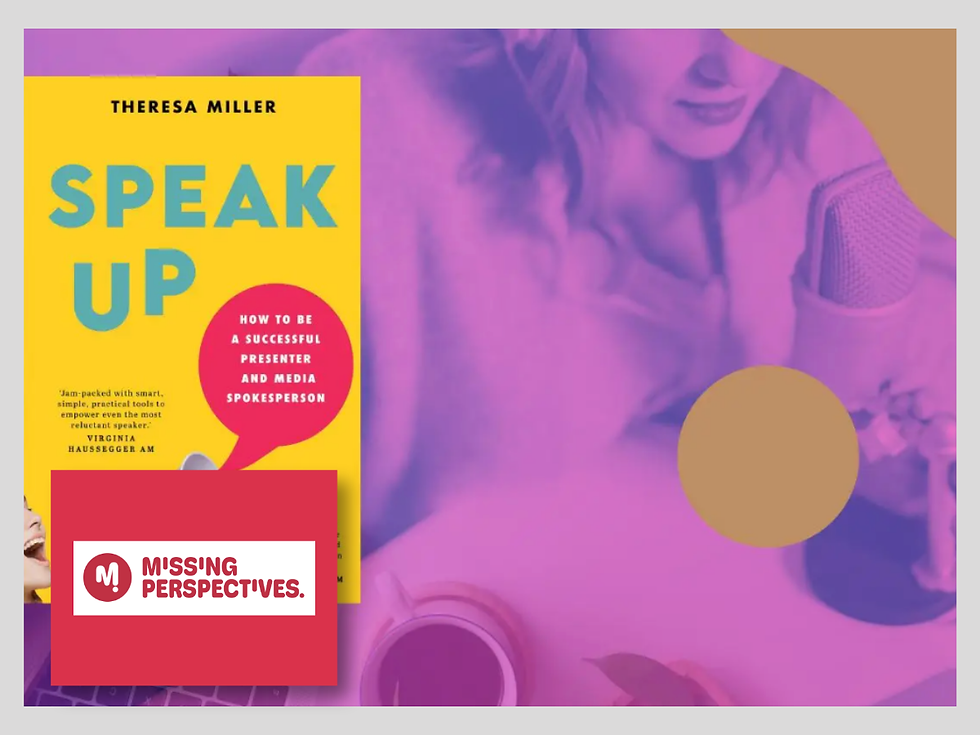
For an easy-to-use guide – read Speak Up – how to be a successful presenter and media spokesperson by Theresa Miller – published by New South Books.
If you’re in Sydney, Theresa Miller is giving a free seminar on May 7 at Waverley library on nailing your work presentation.


Comments